
Laplacian of Gaussian
The Marr–Hildreth edge detector, proposed by David Marr and Ellen Hildreth in 1980. Gaussian smoothing tames the Laplacian's noise, and edges are placed where the response crosses zero, giving closed, smooth contours.
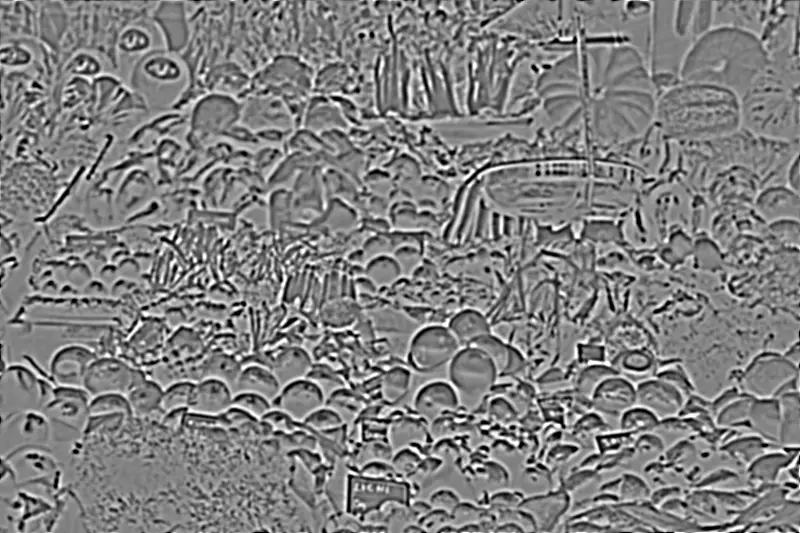
Spot it
- 01Smooth closed contour loops
- 02Soft gray relief shading
- 03Scale-dependent line detail
Why it happens
Blurs the image with a Gaussian, applies the Laplacian second derivative, and marks edges at the zero crossings; the Gaussian width sets the scale of detail kept.
Recreate it in Pixio
Image edit prompt“Convert this image into a Laplacian of Gaussian map: a soft gray field with smooth, closed contour loops where the response crosses zero, shown as thin dark lines between pale and dark halos. Detail is simplified to a medium scale, with little noise. Grayscale only. Keep the original subject and composition recognizable.”
Open PixioUpload your image and pick an image-edit model.