
Blue-Noise Dither
Dithering with a threshold texture whose energy sits at high frequencies, so dots spread evenly without patterns. Robert Ulichney's work on digital halftoning popularized it; it looks like fine film grain.
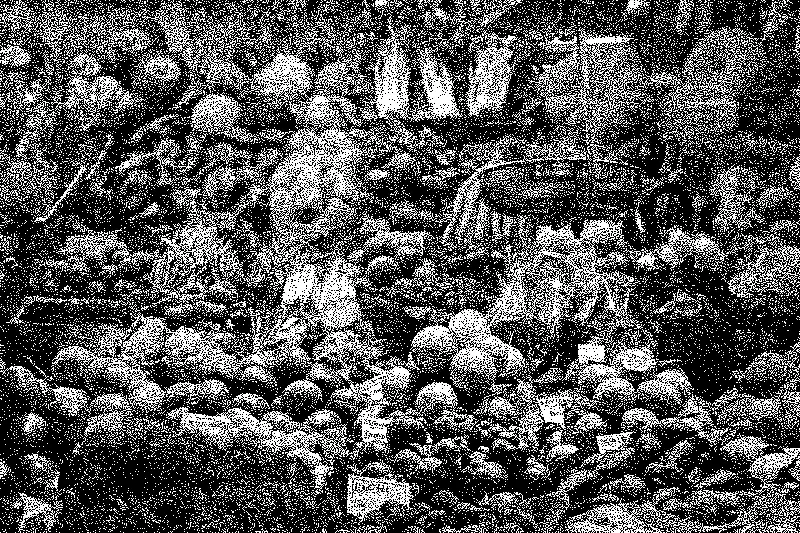
Spot it
- 01Fine even grain
- 02No visible repeating pattern
- 03Smooth organic gradients
Why it happens
A precomputed blue-noise texture serves as the threshold map; pixels turn on or off against it, so errors are scattered evenly and avoid clumps and regular structure.
Recreate it in Pixio
Image edit prompt“Render this image as a black and white blue-noise dither: very fine, evenly distributed grain with no visible grid, worms or repeating pattern, smooth gradients built from isolated tiny dots, crisp 1-bit pixels, a clean high-quality print look. Keep the original subject and composition.”
Open PixioUpload your image and pick an image-edit model.